The Probots
Engineering the Perfect Run
Our robotics journey to the World Championship was filled with highs, lows, and countless hours of testing. To achieve consistency on the competition mat, we had to continuously analyze our failures and implement strategic solutions across our hardware, software, and team workflow.
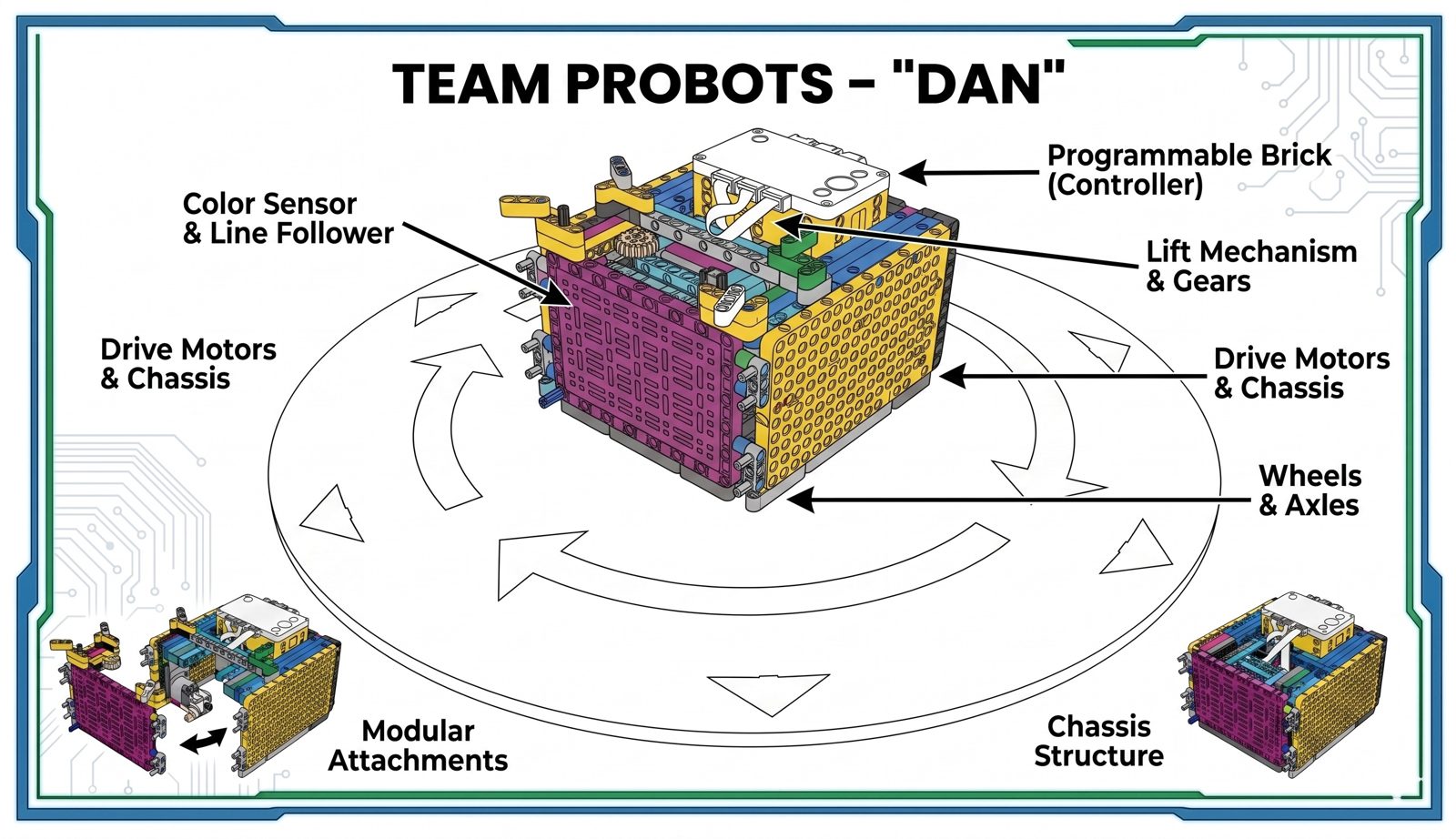
To address inconsistent mission performance, we categorized every task by its required motion and mechanism type. Between Qualifiers and State, we completely redesigned our robot—slimmer chassis, better stability, and a dual-header system capable of running two attachments at once.
We mapped out our runs to group missions by proximity. With versatile attachments that worked actively and passively, our robot completed complex sequences in a single, efficient run.
The SPIKE app caused inconsistent accuracy and Bluetooth issues. Switching to Pybricks allowed code to run directly on the hub—unlocking smoother motor control, precise tuning, and far more reliable autonomous runs.
Assigning missions to individuals slowed us down. We reorganized into two rotating groups—designer, coder, tester— and held weekly team reviews. This doubled our progress and improved communication.
Through active/passive attachments, a double-header design, mission grouping, and advanced Python coding, we dramatically improved our robot’s capabilities and built an engineering portfolio we’re proud of.